
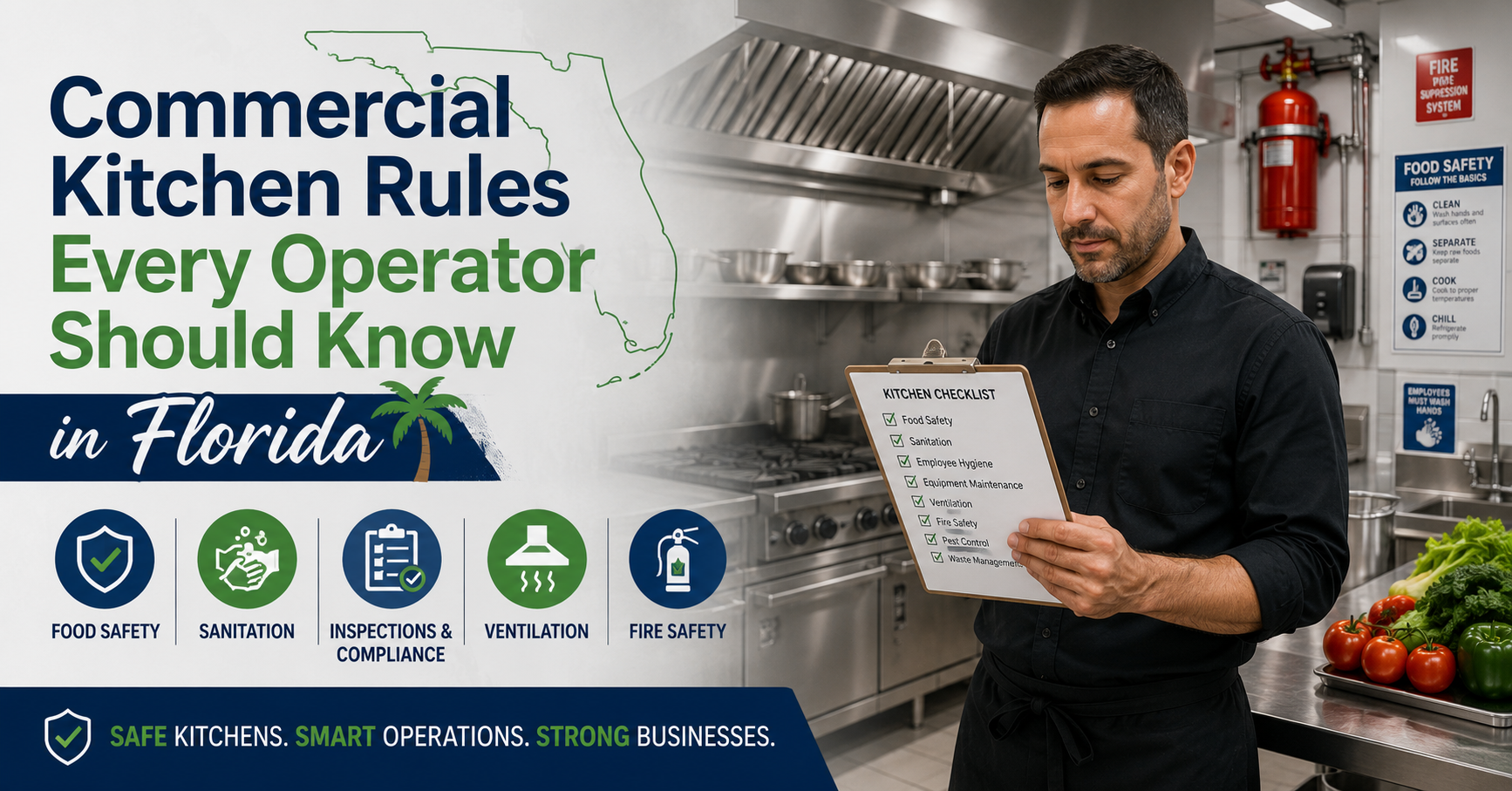
Understanding commercial kitchen requirements in Florida is not optional. It is the difference between opening on schedule and sitting on a completed build while you wait for a re-inspection that could have been avoided.
Florida operates under a specific combination of state licensing requirements, NSF equipment standards, ventilation codes, and county-level inspection processes. What passes in Georgia does not automatically pass here.
If you are planning a restaurant, commissary, or food service operation in the Tampa Bay area, including Tarpon Springs, Pinellas County, or Hillsborough County, this is what you need to have in order before you build.
Florida DBPR Licensing: Where It Starts
A Florida Department of Business and Professional Regulation (DBPR) licenses food service establishments in the state. Before you open, you need a DBPR license for your specific establishment type.
You can review all license types, submission requirements, and the plan review process directly on the DBPR Division of Hotels and Restaurants licensing page.
The license application requires a plan review submission. You submit your kitchen drawings to the DBPR for review, and they evaluate whether the design meets the state’s food service requirements. This happens before construction, or at minimum before you open. Submitting drawings that were not designed with Florida’s requirements in mind is one of the most common reasons projects get delayed.
The DBPR plan review is separate from your local building permit and your county health department inspection. All three have to be satisfied.
NSF/ANSI Equipment Certification: This Is Not a Preference
Florida health inspectors require equipment that is NSF/ANSI certified or listed by an equivalent organization such as UL or ETL. Every piece of equipment that contacts food, stores food, or is used in the preparation or handling of food must meet this standard.
NSF certification means the equipment has been independently tested and verified to meet sanitation and materials requirements. An inspector will check for the NSF mark on equipment during plan review and inspection. Equipment without it will be flagged, and if it is already installed, you may be required to replace it.
This catches operators who buy used equipment without verifying its certification status. Used equipment can be fine, but the certification must follow the unit, not the seller’s assurance.
Ventilation and Fire Suppression Requirements
Florida’s commercial kitchen ventilation requirements are based on the Florida Building Code, which references ASHRAE 62.1 and NFPA 96 for commercial cooking operations. In practice, this means:
Your hood system must be sized to the actual BTU output of your cooking equipment, with appropriate capture velocity. Makeup air must be supplied to prevent negative pressure conditions that pull combustion gases back into the kitchen.
A fire suppression system integrated with the hood is required for cooking equipment that produces grease-laden vapor. This includes ranges, griddles, fryers, and charbroilers.
The fire suppression system has to be inspected and tagged. An inspector will look for the current service tag during their walkthrough.
Pinellas and Hillsborough County Inspection Process
Local county health departments conduct the inspections that ultimately determine whether you pass. Here is how that process typically works in Pinellas and Hillsborough counties.
You submit plans to the county health department as part of your permit application. The county reviews the plans for compliance with Florida’s food service regulations. If the plans are approved, construction proceeds. When construction is substantially complete, you request a pre-opening inspection. The inspector walks the space and evaluates equipment, plumbing, ventilation, pest exclusion, and overall readiness. If items are found that do not meet code, you receive a list and schedule a re-inspection.
Common reasons kitchens fail inspection in this area:
Hand-washing sinks not located where code requires them, or lacking the required soap and towel dispensers at the time of inspection. Equipment that lacks NSF certification or has been modified after certification.
Three-compartment sink not properly configured or not large enough to submerge the largest item used in food preparation. Missing or improperly installed backflow prevention on water connections. Grease interceptor not installed or not sized per the county’s requirements.
The inspection process itself is not adversarial. Inspectors want you to open. They also do not have flexibility on code requirements, and inspectors in Tarpon Springs and the broader Pinellas County area have seen enough projects to spot the common shortcuts quickly.
A Florida Kitchen Compliance Checklist
Use this as a working reference, not a substitute for working with someone who knows local requirements.
DBPR plan review submitted and approved before construction begins. All equipment is NSF/ANSI certified or equivalent (UL, ETL). Hood system sized to equipment load with proper capture velocity.
Fire suppression system installed and currently tagged. Makeup air system installed and balanced. Three-compartment sink large enough to submerge the largest item used. Hand-washing sinks installed at required locations with soap and towel dispensers in place.
Grease interceptor installed and sized per county requirements. Backflow prevention on all water connections to equipment. Pest exclusion measures in place (no gaps at doors, windows, or utility penetrations).
Floors, walls, and ceilings are smooth, non-absorbent, and cleanable in all food preparation areas. Adequate lighting in all food preparation, storage, and warewashing areas.
Why Local Knowledge Matters Here
The letter of the code and the way it gets applied in Pinellas and Hillsborough counties are not always identical. There are judgment calls inspectors make, there are specific things local inspectors have a pattern of flagging, and there are interpretations that have evolved over time. A designer or equipment partner who has worked extensively in this area knows those nuances.
NNN Foodservice Solutions is based in Tarpon Springs and has been working with operators across the Tampa Bay area for decades. We know how these projects get reviewed and what it takes to get them approved. If you are planning a kitchen build or renovation in this area, let’s talk through your project before you finalize your drawings.
For a deeper look at how commercial kitchen design affects compliance from the start, see our complete guide to commercial kitchen design.